Menu

4 Types of Project Managers: Finding Your High-Demand Niche

Here’s something nobody tells you when you start researching this career: “project manager” isn’t one job. It’s an umbrella term covering four genuinely different roles, each with its own tools, its own culture, and its own entry route.
We see this confusion constantly. Someone spends three weeks reading generic career advice, concludes they need a computer science degree, and quietly gives up. That’s a shame, because it’s based on a false premise.
The UK project management market has split into distinct specialisms. Each one draws on a different kind of prior experience, and each one is hiring right now.
Your job isn’t to become “a project manager” in some abstract sense. It’s to identify which of these four lanes matches what you already know, then translate your CV into the language that lane uses.

What Careers Can You Do with Project Management?
Most job seekers fixate on the title “Project Manager” and miss the wider ecosystem sitting underneath it. That’s a mistake, because entry-level roles rarely carry that exact label.
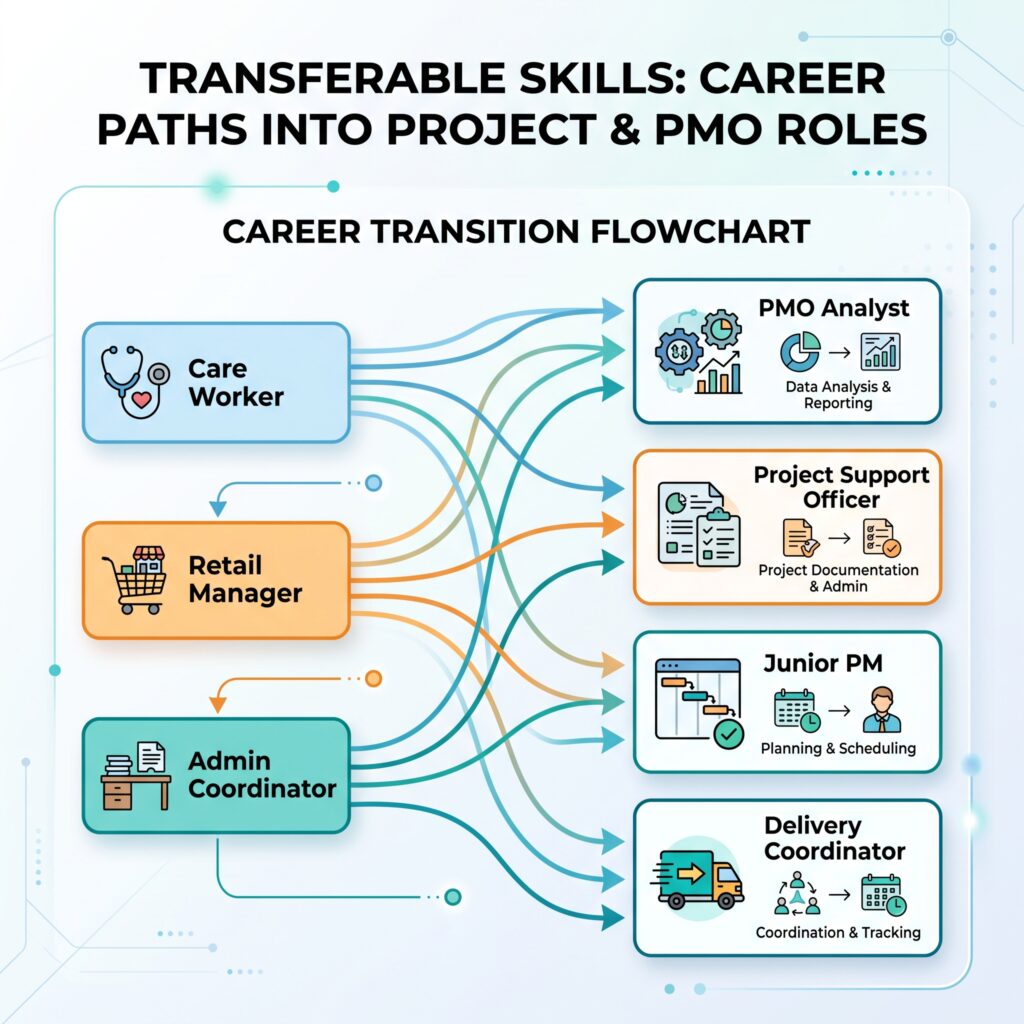
Recruiters and hiring managers use a whole vocabulary of adjacent titles instead. You’ll see Project Support Officer (PSO), PMO Analyst, Delivery Coordinator, Junior Project Manager, and Change Analyst all posted for what is functionally the same skill set at different seniority levels.
A PMO Analyst compiles Highlight Reports and tracks RAID logs across a portfolio of projects; they rarely “manage” a project outright, but they sit close enough to the process to build real, citable experience. A Delivery Lead, by contrast, owns outcomes directly and answers to a Steering Committee.
This matters because it changes your job search strategy entirely. Instead of applying only for roles titled “Project Manager” (where you’ll compete against candidates with five years’ experience), you widen your net to include PSO, PMO Analyst, and Coordinator roles, where your transferable skills are genuinely competitive.
We built our own Bootcamp around this exact insight: get people into the PMO ecosystem first, then let internal mobility do the rest.
Career pathway diagram showing transferable roles into project management from care, retail, and admin backgrounds.

The 4 Core Profiles Dominating the UK Market

Right, let’s get concrete. Four profiles dominate UK hiring boards. We’ll map each one to the industries it serves and the background it tends to reward.

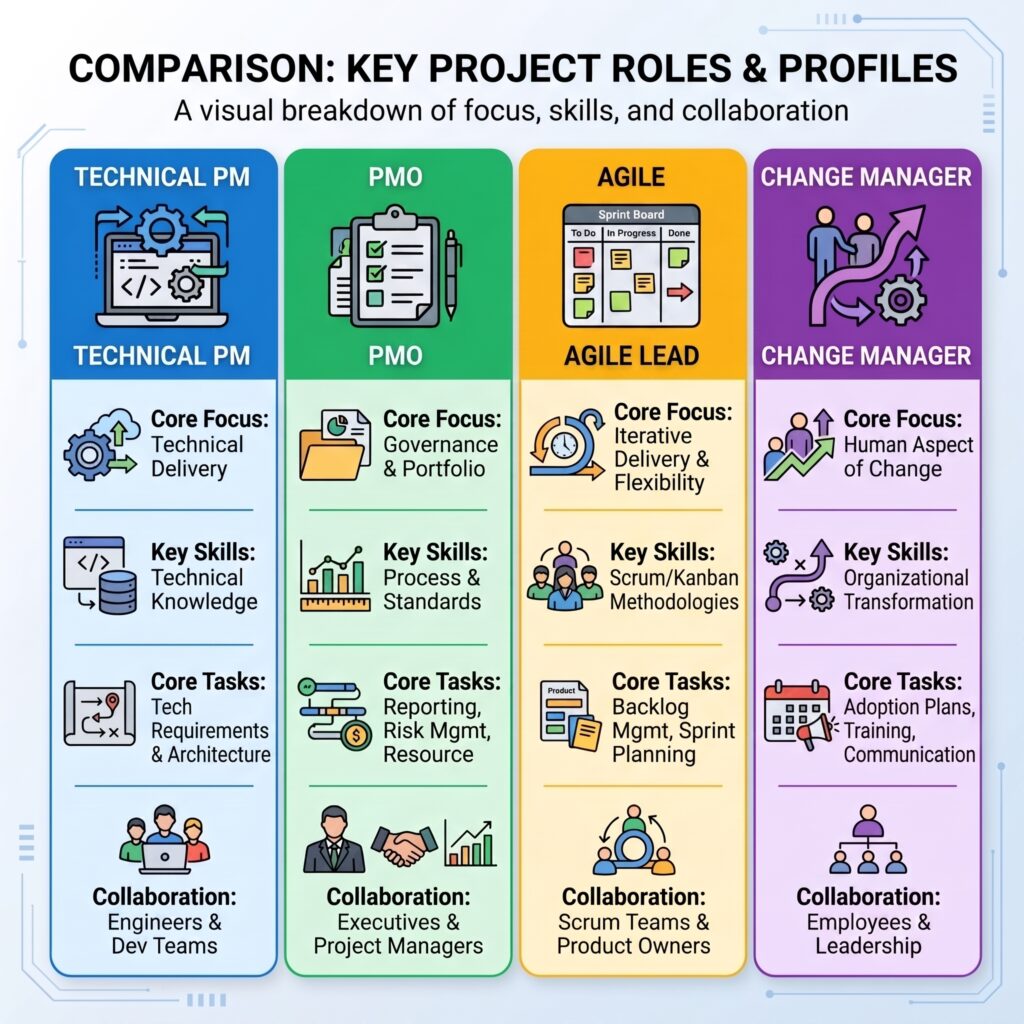
1. The Digital & Technical Project Manager

This is the profile most people picture first, and it’s the one that intimidates career switchers most.
Technical PMs sit inside software houses, fintechs, and internal IT departments. They’re responsible for coordinating app deployments, managing integration timelines between systems (think a hospital trust migrating patient records to a new database), and translating developer jargon for non-technical stakeholders.
You don’t need to code. What you need is fluency in Agile ceremonies (stand-ups, sprint reviews), comfort with tools like Jira or Azure DevOps, and the ability to sit in a room full of engineers without freezing up.
Former retail operations managers often slot into this world faster than expected, because retail already runs on tight release cycles; think Black Friday deployment windows and constant stakeholder juggling.

2. The PMO (Project Management Office) Specialist

This is our favourite entry point, and honestly, it’s the one we push hardest in our own Bootcamp.
PMO specialists don’t run projects. They govern them. That means building and maintaining RAID logs (Risks, Assumptions, Issues, Dependencies), compiling weekly Highlight Reports for senior leadership, and enforcing Change Control processes so scope doesn’t quietly balloon.
Reporting structures here tend to be formalised, with templates dictated by the PMO function rather than improvised by individual project leads. If your background involves compliance, safeguarding documentation, CQC audit prep, or care plan reviews, you already understand structured, evidence-based reporting at a level most fresh graduates simply don’t.
A former care coordinator we worked with described her old job as “constant risk assessment with a paper trail.” That’s a RAID log. She just hadn’t been told the corporate name for it yet.

3. The Agile & Scrum Practitioner

Agile practitioners live inside sprints – usually two-week cycles – running retrospectives, managing product backlogs, and keeping cross-functional squads (design, dev, QA) moving in the same direction.
Titles here include Scrum Master, Agile Delivery Manager, and Product Owner-adjacent Coordinator roles. The certification that opens doors fastest is a Scrum Alliance CSM or an APM PFQ with an Agile module.
What gets you shortlisted isn’t theoretical knowledge of the Agile Manifesto. It’s evidence you can facilitate a room, manage conflicting priorities under time pressure, and protect a team from scope creep mid-sprint.
Teachers and classroom leads transition into this profile unusually well. Running a lesson plan against a fixed 50-minute clock, adapting on the fly, and managing 30 competing needs simultaneously is Scrum practice by another name.

4. The Operational & Business Change Manager
This profile gets overlooked, which is odd, because it’s arguably the most transferable one on this list.
Change Managers handle the human side of transformation: a company restructuring its regional offices, a public sector body responding to a new regulatory framework, or a merger requiring two workforces to adopt one shared process. Their tools are Stakeholder Impact Assessments, Communication Plans, and Benefits Realisation tracking.
Former care supervisors, logistics coordinators, and retail area managers carry a hidden advantage here: they’ve already managed people through disruptive change, whether that’s a new rota system, a CQC inspection response, or a warehouse process overhaul.
We routinely see candidates from these backgrounds outperform business graduates in Change Manager interviews, purely because they can speak to lived examples of managing resistance and communicating difficult transitions to real teams.
"Visual comparison of four project management career profiles: Technical, PMO, Agile, and Change Management."

Beyond the Basics: The 7 Types of Project Management Methodologies

Every job advert will mention a methodology, and if you can’t speak to it fluently, you won’t get past the ATS screening on Workday or Greenhouse. Let’s demystify this quickly, because it’s simpler than the training providers make it sound.

Methodologies split broadly into two families. Predictive approaches (Waterfall, PRINCE2) plan the entire project upfront, with sequential, Stage Gate phases and formal sign-off at each transition. Adaptive approaches (Agile, Scrum, Kanban) build iteratively, adjusting the plan as new information arrives.

Methodology Type Best Suited To UK Employers Who Favour It
PRINCE2 Predictive Government, construction, regulated sectors NHS, local councils, defence
Waterfall Predictive Fixed-scope, fixed-budget builds Engineering, infrastructure
Agile Adaptive Software, product development Fintech, startups, tech scale-ups
Scrum Adaptive Sprint-based team delivery SaaS companies, digital agencies
Kanban Adaptive Continuous flow, support functions IT operations, service desks
Lean Hybrid Waste reduction, process efficiency Manufacturing, logistics
Hybrid (PRINCE2 Agile) Blended Large organisations needing governance + speed Banks, insurers, large retailers
A hybrid approach, PRINCE2 Agile is the most commonly certified version, is increasingly what UK employers actually want. They need the governance rigour of PRINCE2 layered over the delivery speed of Agile sprints. That’s not a contradiction; it’s simply how most mature organisations now operate.

The Top 5 Skills of a Project Manager That Actually Get Shortlisted

Forget vague competencies. Here’s what’s specifically checked at CV screening stage and interview:

1. RAID log management: proving you can track risks, assumptions, issues, and dependencies without letting anything slip through unnoticed.

2. Resource scheduling: evidence you’ve allocated people, budgets, or equipment against a fixed timeline (a 22-person shift rota counts; so does a project resourcing plan).

3. Change control: demonstrating you understand formal scope change requests, rather than letting projects drift.

4. Governance reporting: the ability to produce a clear, concise Highlight Report that a senior stakeholder can read in ninety seconds.

5. Stakeholder matrix management: mapping who needs to be consulted, who needs to be informed, and who actually holds the budget.

None of these require a computer science degree. All of them are skills a care coordinator, an admin lead, or a retail supervisor has almost certainly already practised, just without the corporate label attached.

The 80/20 Rule for Project Managers: Managing Delivery Stress
Here’s a principle that separates burnt-out juniors from calm, effective seniors: the 80/20 rule, or Pareto Principle, applied to delivery.
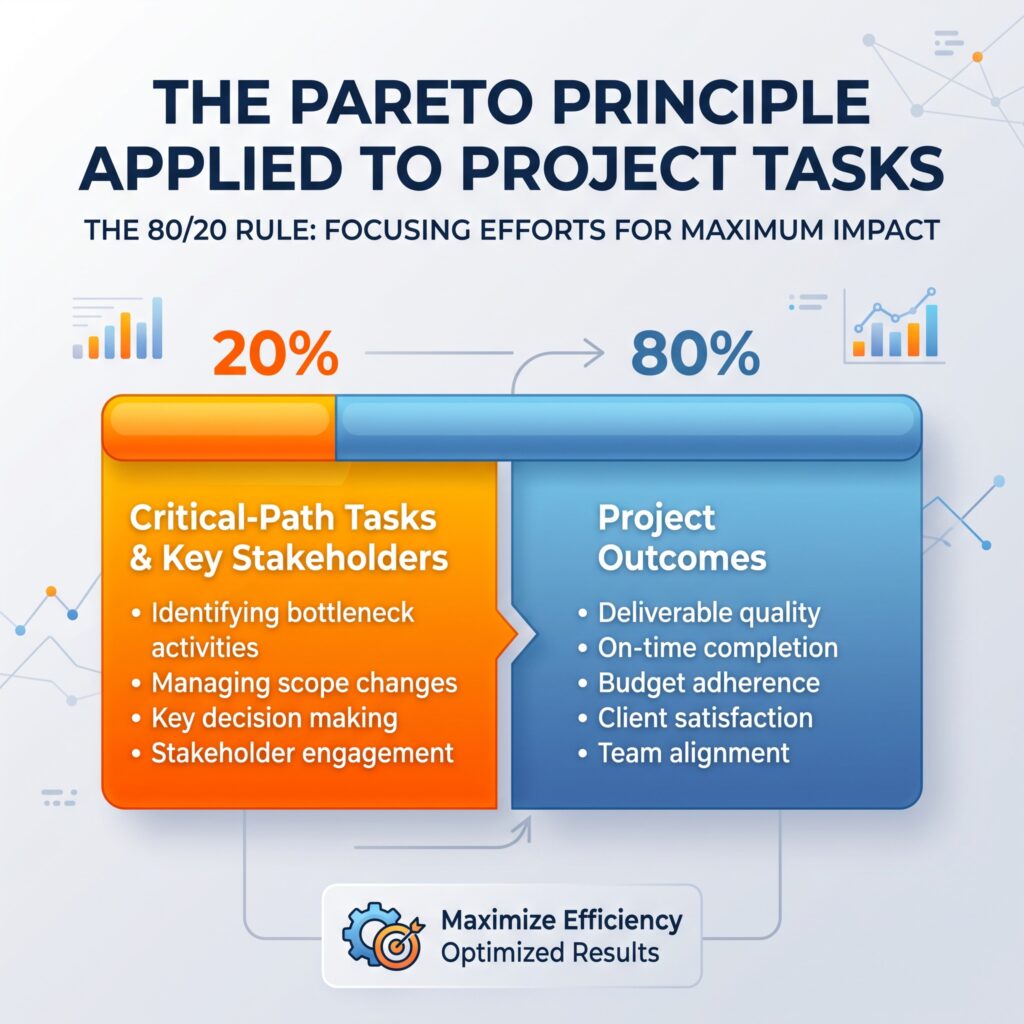
Roughly 20% of your tasks and stakeholders generate 80% of your project’s risk and outcome. A sponsor who controls budget approval matters more than five junior team members combined. A single dependency on the critical path matters more than a dozen minor administrative tasks.
Effective PMs triage ruthlessly. They protect their energy for the handful of relationships and tasks that genuinely move the needle, rather than treating every email and every stakeholder as equally urgent.
This is also, frankly, the single biggest burnout-prevention tool in this profession. New PMs who try to be equally responsive to everyone and everything usually last about six months before they’re exhausted. The ones who last five years have learned to say “that’s not on the critical path” and mean it.
"80/20 rule diagram for project managers showing how 20% of critical tasks drive 80% of project success."

Frequently Asked Questions

PMO Analyst and Project Support Officer roles are seeing the strongest entry-level demand right now, largely because organisations need governance capacity faster than they can train it internally. Technical PM roles remain competitive but require more specific tooling experience.

Yes, though it’s usually easier to enter via PMO or Change Management first, then move sideways into technical delivery once you’ve built internal credibility and a live project track record. Employers rarely gatekeep on coding ability for PM roles; they gatekeep on evidence of structured delivery experience.

PRINCE2 is a predictive, stage-based methodology built around formal sign-off and documentation at each phase. Agile is an adaptive framework built around iterative sprints and evolving requirements. Most UK employers now blend the two, expecting familiarity with both rather than pure loyalty to one.

wpChatIcon
wpChatIcon