
Is a Project Coordinator a Stressful Job? (The Honest Truth)
Let’s answer this honestly, without the marketing spin. Yes, the role carries pressure. But it isn’t the kind of stress you’re used to if you’ve come from care, teaching, or retail.
Here’s the honest comparison. In a care setting, you might handle a physical emergency, a safeguarding concern, and a staffing gap, all before lunch. That’s acute, unpredictable stress. A Project Coordinator’s stress is different: it’s administrative and cognitive. It’s the low hum of “did the supplier confirm delivery by Friday?” not the adrenaline spike of a resident falling.
We’re not saying it’s easy. The accountability is real; if a RAID log goes stale or a Highlight Report misses a red flag, someone senior notices. But nobody’s physical safety depends on your Tuesday afternoon. That distinction matters, and it’s worth sitting with if you’re weighing up whether this career switch is right for you.
The mental load is different in shape, not necessarily lighter in weight. You’re holding dozens of small threads; action points, dependencies, dates; in your head at once. It’s more like conducting an orchestra of admin than putting out fires. For many switching out of frontline roles, that’s a welcome trade.
The Core Pressures: Tracking Deliverables Without Direct Authority
Here’s the real stress trigger, and nobody tells you this before you start. You are responsible for a project’s milestones. You do not manage the people delivering them.
Say a Stage Gate review is booked for Thursday. Your job is to confirm that Finance has signed off the budget line and that IT has completed testing. You have zero line-management authority over either team. If they’re late, it’s still logged against your tracker.
This is where new coordinators burn energy unnecessarily, chasing people who technically outrank them and feeling awkward about it. The fix isn’t confidence, it’s structure.
Build a follow-up cadence and stick to it religiously:
| Cadence Stage | Action | Tone |
|---|---|---|
| Day 1 | Initial request logged in tracker, deadline stated | Neutral, factual |
| Day 3 (if silent) | Polite chase via email, Cc line manager if relevant | Friendly reminder |
| Day 5 (if silent) | Flag as amber risk in Highlight Report | Escalation, not blame |
| Day 7 (if silent) | Raise at stand-up, request PM intervention | Formal escalation |
Once this becomes muscle memory, the anxiety drains out of the chase. You’re not nagging anyone, you’re following a documented process, and that reframing alone removes most of the emotional weight new coordinators carry.

Workplace Mechanics: How Many Hours Does a Project Coordinator Work?
This is where care workers and retail managers genuinely light up when they hear the answer. Predictability is the headline feature.
There’s no rota published three weeks late. There’s no mandatory overtime because someone called in sick for a Sunday shift. The structure of corporate UK working hours is, frankly, blissfully boring compared to shift-pattern industries.
Standard Hours vs. Deployment Windows: What Is Normal?
Most UK Project Coordinator roles sit at 37.5 to 40 hours per week, typically Monday to Friday, often with some flexibility on start times (8:30–9:30am is common). Many organisations now offer hybrid arrangements, two or three days in the office, the rest remote.
A typical Tuesday looks like this: update the project plan, chase two outstanding actions, sit in on a 30-minute stand-up, format a Highlight Report, respond to fifteen emails. Nothing about that day requires you to stay past 5:30pm.
Where it shifts is around deployment windows, go-live dates, system migrations, contract renewals with hard deadlines. In the run-up to a go-live, you might see genuine overtime: a late finish the night before, or being on call during the migration weekend itself. This is the exception, not the pattern, and it’s usually time-limited to a handful of days per project.
Compare that with retail during a Boxing Day sale, or care work during a winter norovirus outbreak, and the difference is stark. Corporate deadline pressure is scheduled and visible weeks in advance. You can see it coming on the project plan, which means you can prepare for it rather than being ambushed by it.
Evaluating the Value: Is a Project Coordinator an Entry Level Role?
Broadly, yes, and that’s exactly why it’s the door career switchers should be walking through. Most job specs list it as requiring 0–2 years of direct project experience, with transferable organisational skills from any background counted favourably.
What makes it more than “just” entry level is what it unlocks. This isn’t a dead-end admin job; it’s a feeder role into the entire PMO and project management career track. Employers hire coordinators knowing a proportion will progress into PMO Analyst or Junior Project Manager positions within 18–24 months.
Salary of a Project Coordinator: Does the Pay Match the Pressure?
Let’s talk numbers. Vague reassurance doesn’t pay the rent. Across UK salary data from Indeed, Glassdoor, and Reed, entry-level Project Coordinator roles typically sit between £27,000 and £35,000+, with London and specialised sectors (finance, tech, infrastructure) pushing toward the higher end.
Reed currently lists live IT Project Coordinator vacancies at £28,000–£30,000 outside London. Glassdoor’s UK entry-level data puts the typical range between roughly £25,000 and £38,000 depending on employer size and region.
| Level | Typical UK Salary Range | Notes |
|---|---|---|
| Entry-level Coordinator | £27,000–£31,000 | Regional/SME employers |
| Coordinator, London/specialist sector | £30,000–£38,000 | Finance, tech, infrastructure |
| Progression to PMO Analyst | £32,000–£42,000 | Typically after 12–24 months |
| Progression to Junior PM | £35,000–£45,000+ | PRINCE2 or APM PFQ often expected |
Is the pay proportionate to the pressure on day one? Roughly, yes, for a role with genuinely manageable hours. But the honest framing is this: the first six to twelve months are an investment period. You’re building the vocabulary: RACI, MoSCoW, Change Control, that unlocks the next salary bracket. Career switchers who treat year one as paid training, rather than a final destination, tend to progress fastest.

Mental Toolkits: Frameworks to Protect Your Work-Life Balance
You don’t need a PRINCE2 qualification on day one to think like a project professional. A handful of mental models will carry you further than raw effort ever will, and they’ll stop workplace friction from following you home.
The 5 Cs of Project Management as a Mindset Filter
The 5 Cs: Complexity, Control, Communication, Competence, and Compliance aren’t just theory for an exam. Used properly, they’re a filter that stops you internalising every hiccup as personal failure.
Supplier late again? That’s a Control issue (dependency outside your authority), not a reflection of your organisational skills. Stakeholders confused about scope? That’s a Communication gap, fixable with a clearer update, not evidence you’re bad at your job.
Coordinators without this filter tend to absorb tracking failures emotionally. Those with it ask, ‘Which of the 5 Cs is this?’ and respond with a process fix, not a personal spiral.
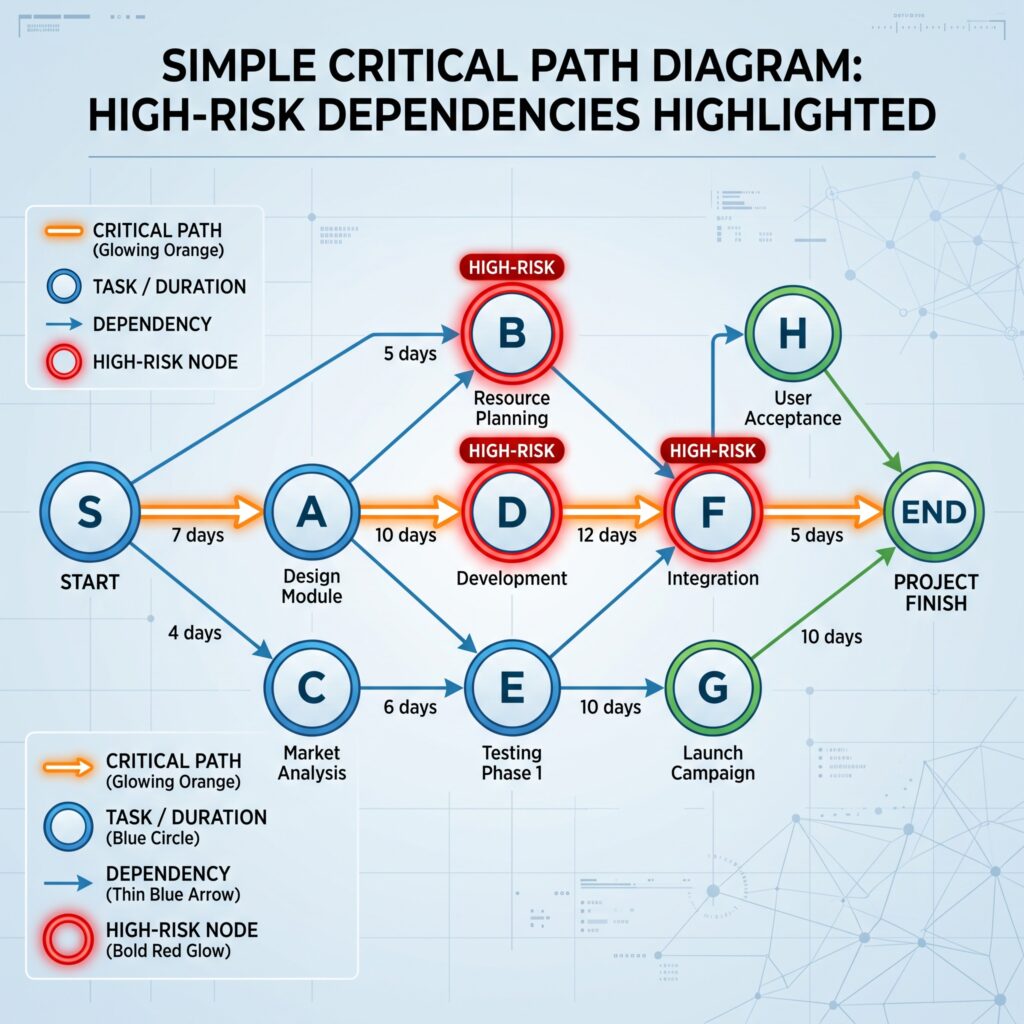
The 80/20 Rule: Focus on the Critical Path
Here’s a statistic worth memorising: roughly 80% of project delays are caused by 20% of high-risk dependencies, usually the same two or three suppliers, approvals, or resource bottlenecks on any given project.
Instead of chasing all thirty action points with equal intensity, identify the critical path items early, the ones that, if delayed, push the whole go-live date. Everything else can wait a day without consequence.
This single habit is what keeps working hours contained. Coordinators who try to treat every task as equally urgent are the ones staying late. Coordinators who triage ruthlessly go home on time, because they’ve stopped manufacturing false urgency out of low-risk admin.

Frequently Asked Questions
Frontline management stress is physical and immediate: staffing gaps, safety incidents, customer conflict happening in real time. Project Coordinator stress is cognitive and scheduled, dependency tracking and status chasing you can see coming days in advance. It’s lower-adrenaline, higher-organisation.
Largely, yes. Standard weeks run 37.5–40 hours with predictable start and finish times. Expect occasional late finishes only around go-live or migration windows, not as a weekly pattern.
Most coordinators progress to PMO Analyst or Junior Project Manager within 12–24 months, often supported by PRINCE2 Foundation or APM PFQ certification. Salary typically jumps by £5,000–£10,000 at that stage.
@ReallyNotRocketScience
Copyright 2023 - All Rights Reserved By Ninos Global Tech
