
How to Become a Project Manager Without a Degree (The UK Blueprint)
We built this brand on that exact premise. The barrier isn’t a skills gap. It’s a translation gap. You already do project work. You just call it something else.
How Long Does it Take to Become a Project Manager in the UK?
Navigating UK Project Manager Qualifications: Which Move the Needle?
We’re going to be direct about something the training industry tends to blur: a certificate alone rarely gets you hired. It gets your CV read. What gets you hired is the certificate combined with a CV that’s been rebuilt to show you’ve already been doing this work under a different job title.
PRINCE2 vs APM: Choosing the Right Pathway for Your Sector
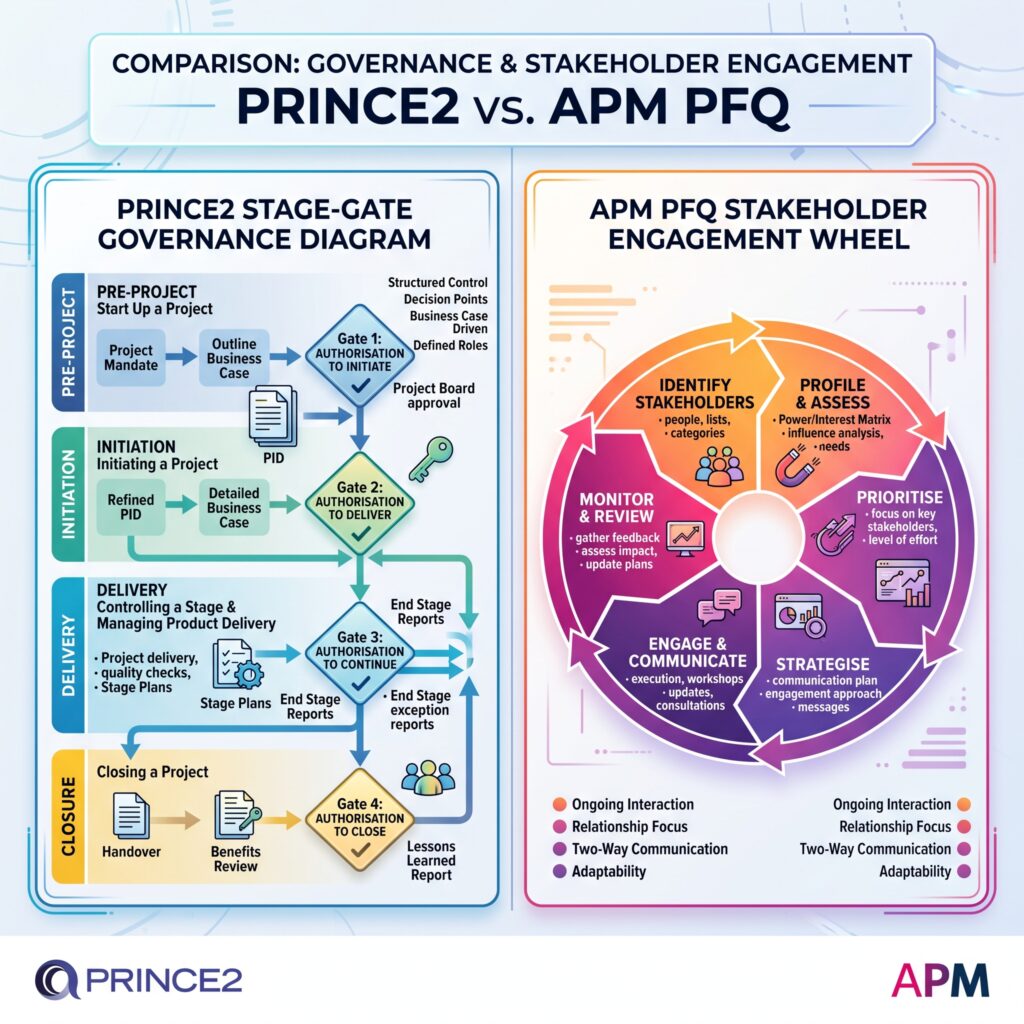
PRINCE2 was developed under UK government direction, and that lineage still shows. It dominates the NHS, central and local government, defence, construction, and large infrastructure frameworks, precisely because those environments run on tightly governed stage gates, formal sign-offs, and audit trails. If your target is a PMO Analyst role inside an NHS trust or a council, PRINCE2 is the password that gets you through the door.
The APM Project Fundamentals Qualification (PFQ), by contrast, is the one you’ll see requested far more often in private-sector corporate roles, digital agencies, and tech-adjacent PMOs. It sits at SCQF Level 6 and leans harder into the behavioural and stakeholder side of project delivery rather than the rigid governance structure PRINCE2 is known for.
Is PRINCE2 Equivalent to a Degree?
What Subjects or Skills Should You Master First?
Risk registers. Learn to identify, log, score, and escalate a project risk, not just define what one is. Every care coordinator who’s managed a staffing shortfall has done this instinctively; you just need the RAID log vocabulary to describe it.
Stakeholder communication planning. Who needs updates, how often, and in what format. If you’ve ever managed communication between families, GPs, and social workers, you’ve been doing stakeholder mapping without the label.
Milestone tracking. Understanding how a project breaks into phases with checkpoints, and how a Highlight Report communicates progress against those checkpoints to senior stakeholders.
Basic project lifecycle management. Initiation, planning, execution, closure. Simple on the surface, but it’s the spine that every PRINCE2 and APM answer hangs off in an interview.
Master these four before you sit any exam, and the qualification becomes a formality that confirms what you already understand, rather than a wall of unfamiliar jargon you’re memorising cold.
Financial Reality: Evaluating the Real PRINCE2 Cost in the UK
Self-Study vs. Classroom Bootcamps: Exam and Course Fees
A fully accredited classroom or virtual course: including tuition, practice exams, and the exam voucher, generally lands between £700 and £1,300, depending on the provider and whether you choose in-person or virtual delivery. Combined Foundation and Practitioner packages push higher again, often £1,400 to £2,200, though Practitioner isn’t necessary for most entry-level roles.
APM PFQ runs cheaper across the board: exam-only vouchers sit around £197 to £280, while full courses with tutor support typically fall between £330 and £550.
Budget matters. But here’s the part we won’t soften: a certificate sitting on top of an untranslated CV will still fail an ATS scan. Applicant tracking systems used by employers and agencies — Workday, Greenhouse, the systems Hays and Reed candidates get filtered through — are matching keywords against job descriptions. If your CV still reads “supported service users with daily routines” instead of “coordinated resource scheduling across a 12-person team using structured escalation protocols,” no certificate on earth fixes that mismatch on its own.
The qualification opens the conversation. The CV rebrand gets you into the room. You genuinely need both.
Frequently Asked Questions
Can I be shortlisted for UK Project Coordinator roles while my certification is still in progress?
Yes, frequently. Many job adverts state "PRINCE2 or working towards" as an acceptable minimum. Listing your exam date and study progress on your CV signals genuine commitment rather than a gap.
Do I need to pay for a university degree to pass a corporate UK project management screening?
No. Most entry-level PMO and Project Coordinator screenings are built around named certifications (PRINCE2, APM PFQ) and demonstrable competencies, not academic degree requirements. A degree helps, but it isn't the gatekeeper here.
What is the single cheapest way to get certified in a recognized UK project framework?
An APM PFQ self-study exam voucher, currently around £197 to £280, is typically the lowest-cost entry point. Pair it with free study resources and the APM's own practice materials to keep spend to a minimum.
@ReallyNotRocketScience
