
What Does a Project Coordinator Do Day to Day? (The Daily Routine)

A Typical Day for a Coordinator: A Morning-to-Afternoon Breakdown
09:00: Chasing the RAID log. You open the project’s Risk, Assumption, Issue and Dependency log first thing. Three actions were due yesterday. Two people haven’t responded to your Friday email. You send polite-but-firm follow-ups, because a stale RAID log is the single fastest way for a project to quietly go off the rails.
11:00: Supporting the cross-functional alignment meeting. Finance, IT, and the client-facing team are in the same call, and it’s your job to track it. You’re not leading the discussion. You’re capturing decisions, noting who owns what, and flagging anything that contradicts what’s already in the schedule.
Minutes go out within the hour. Not the next day. Within the hour, because delayed minutes are where miscommunication breeds.
14:00: Updating the schedule. Updating the schedule. You compare actual progress against the plan. A supplier delivery has slipped by four days. You update the Gantt chart, note the knock-on effects for testing, and flag it in the tracker before it becomes tomorrow’s crisis.
16:00: Escalating a new issue. Someone on the finance side just mentioned, almost in passing, that a cost code was set up incorrectly. This is exactly the kind of thing that seems small until it isn’t. You log it as a formal issue and escalate it to the Project Manager before you leave for the day.
Repetitive? Somewhat. Predictable? Mostly. Important? Enormously, because projects don’t fail from one dramatic disaster. They fail from twelve small things nobody tracked properly.
Key Duties and Responsibilities of a Project Coordinator
The role breaks into a handful of clear workstreams, and every single one produces a tangible artefact. No vague responsibilities here, everything you do leaves a document trail.
The Jargon Shock: What a New Coordinator Needs to Know on Day One
| Duty Area | What You're Actually Doing | Artefact Produced |
|---|---|---|
| Action tracking | Chasing owners for overdue tasks | Updated RAID log |
| Meeting support | Capturing decisions and owners in real time | Minutes and action list |
| Schedule maintenance | Comparing planned vs actual progress | Updated project schedule |
| Supplier follow-up | Confirming delivery and dependency dates | Vendor status tracker |
| Reporting | Summarising status for senior stakeholders | Highlight Report |
Coordinator Daily Tasks: Managing the Project Governance Trail
Key Skills Needed for a Project Coordinator that Switchers Already Own
- You ran a care home rota with fourteen staff across three shifts, juggling sickness and last-minute cover. That’s a resource schedule; the exact document a coordinator maintains for project staffing.
- You processed supplier invoices against a fixed monthly admin budget and flagged anything that looked wrong. That’s budget tracking against a RAID log entry, essentially unchanged in structure.
- You kept a whiteboard or shared spreadsheet updated so the whole team knew who was covering what, and when. That’s a status report, produced under a different name in a different sector.
The skill was never “organisation” in the abstract. It was always: maintain a live document, keep it accurate, and make sure the right people see it before it’s too late to act. You’ve been doing this the whole time. We’re just renaming the folder.

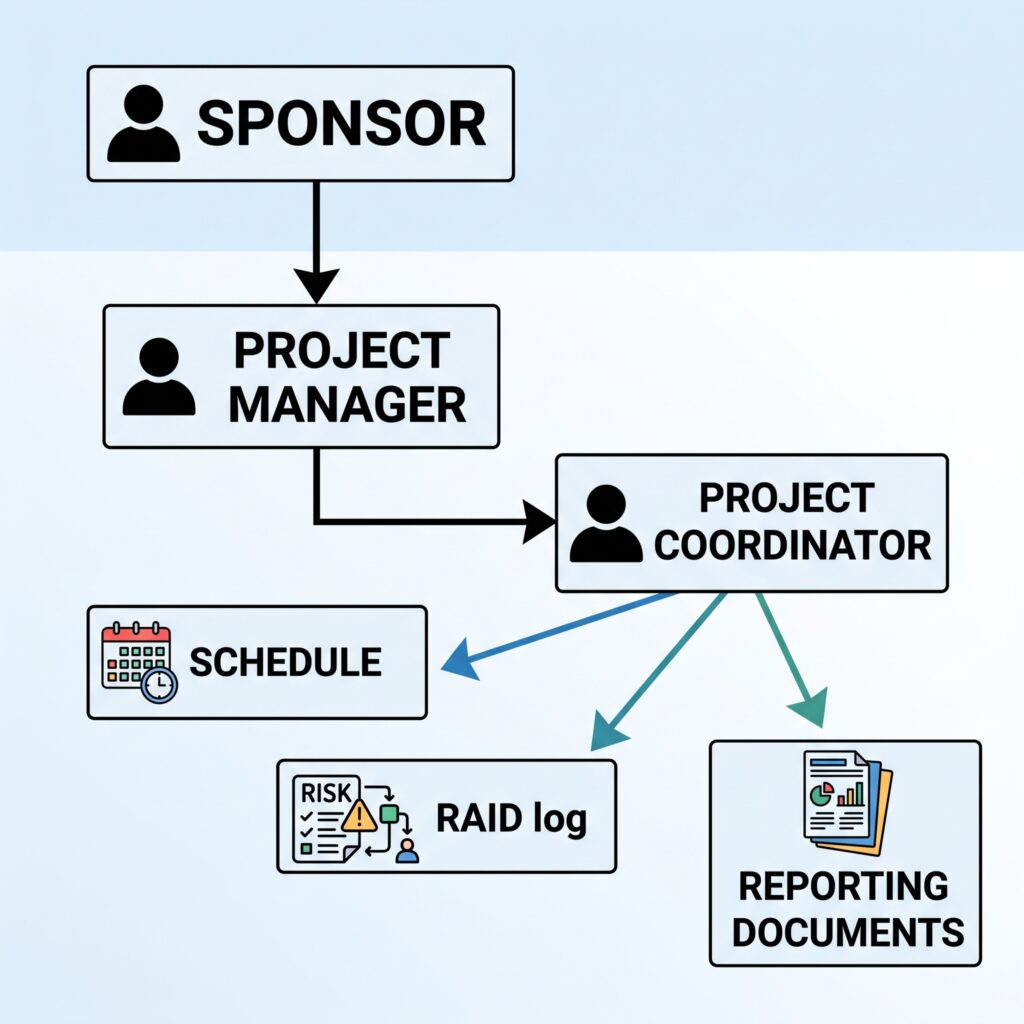
Structural Clarity: Understanding the Difference Between PM and PC
Which is Higher: A Project Manager or a Project Coordinator?

Frequently Asked Questions
Chasing outstanding actions on the RAID log or action tracker. It’s the single task that happens without fail, every working day, regardless of what project or sector you’re in.
No. You need to be comfortable reading a spreadsheet, spotting a variance between planned and actual progress, and flagging it clearly. That’s tracking, not analysis.
If you’re preparing for a move into PMO or project coordination and want structured, practical support before your first day arrives, our 6-Week Project Management and PMO Bootcamp walks you through exactly this transition: real projects, real terminology, real confidence, before you ever need it on the job.
@ReallyNotRocketScience
